
Quartz kitchen countertops typically cost between $40 and $100 per square foot installed, making them a mid-range option that rivals natural stone. The final price depends on slab quality, brand, edge profiles, and installation complexity. This guide breaks down every cost factor so you can budget confidently for your next kitchen upgrade.
If you are planning a kitchen renovation, you have probably wondered about quartz kitchen countertops and what they really cost. The price tag can surprise you, especially when you start factoring in installation, edge profiles, and brand differences. Let us break it all down so you know exactly what to expect.
Quartz kitchen countertops are one of the most popular choices in modern homes. They look stunning, feel durable, and come in a huge range of colors and patterns. But how much are they really worth? That is the question we will answer in this guide. We will walk through every cost factor, compare brands, and share practical tips to help you make the best decision for your budget and your kitchen.
Key Takeaways
- Average Cost Range: Most homeowners pay $40 to $100 per square foot for installed quartz kitchen countertops.
- Brand Matters: Premium brands like Cambria and Caesarstone cost more than budget options like Silestone.
- Thickness Affects Price: Thicker slabs (3cm vs 2cm) increase the cost by 10-20%.
- Installation Complexity: intricate edge profiles, seams, and backsplash integration add to the total.
- DIY Is Risky: Cutting and installing quartz yourself can lead to costly mistakes and voided warranties.
- Long-Term Value: quartz kitchen countertops boost home resale value and require minimal maintenance.
- Get Multiple Quotes: Always compare at least three quotes from different fabricators to find the best deal.
📑 Table of Contents
- What Are Quartz Kitchen Countertops?
- How Much Do Quartz Kitchen Countertops Cost?
- Factors That Affect Quartz Countertop Pricing
- Quartz vs Other Countertop Materials
- How to Save Money on Quartz Countertops
- Are Quartz Kitchen Countertops Worth the Investment?
- Common Mistakes to Avoid When Buying Quartz Countertops
- Expert Tips for Choosing the Perfect Quartz Countertop
- Frequently Asked Questions
- Conclusion
What Are Quartz Kitchen Countertops?
Quartz kitchen countertops are engineered stone surfaces made from about 90-95% natural quartz crystals mixed with resins, pigments, and binding agents. The result is a non-porous, incredibly durable surface that looks like natural stone but performs even better in many ways. Unlike granite or marble, quartz does not need sealing and resists stains and scratches extremely well.
Manufacturers create quartz slabs in controlled factory environments. This means every slab has consistent color and pattern. You do not have to worry about unexpected veining or color variations like you might with natural stone. The consistency of quartz kitchen countertops is one of the biggest reasons homeowners love them.
How Quartz Is Made
The manufacturing process starts with mining natural quartz crystals. These crystals are ground into fine particles and mixed with polymer resins and color pigments. The mixture then gets poured into large molds and subjected to extreme vibration and pressure. Finally, the slabs are heated in kilns to cure them into solid, dense surfaces. This engineering process is what gives quartz kitchen countertops their impressive strength and non-porous surface.
Why Quartz Is So Popular
There are several reasons why quartz kitchen countertops have become the go-to choice for modern kitchens. First, they require very little maintenance. You just wipe them with soap and water. Second, they come in thousands of designs, from marble-look patterns to solid colors. Third, they are incredibly durable and can last 15 to 25 years with proper care. These benefits make quartz a smart investment for any kitchen renovation.
How Much Do Quartz Kitchen Countertops Cost?
The cost of quartz kitchen countertops varies widely depending on several factors. On average, you can expect to pay between $40 and $100 per square foot for a fully installed quartz countertop. This includes the material, fabrication, and professional installation. Let us look at the price breakdown more closely.
Price Range by Quality Tier
Not all quartz is created equal. Manufacturers offer different quality tiers, and the price reflects this. Here is a general breakdown of what you can expect:
- Budget Tier ($40-$55/sq ft): These are entry-level quartz options from brands like Q Quartz or Cambria Brittanicca Warm. They offer solid durability and decent aesthetics but may have fewer color options.
- Mid-Range Tier ($55-$75/sq ft): This is where most homeowners land. Brands like Silestone, Caesarstone, and Cambria offer a great balance of quality, design variety, and durability at this price point.
- Premium Tier ($75-$100+/sq ft): Top-tier brands like Cambria, Caesarstone Concetto, and high-end Silestone collections fall here. These slabs feature unique patterns, superior durability, and exclusive designs.
Cost Breakdown by Component
Understanding what makes up the total cost of quartz kitchen countertops helps you see where your money goes. Here is a typical cost breakdown for a standard 30-square-foot kitchen:
- Material Cost: $1,200 to $3,000 depending on brand and slab quality
- Fabrication Cost: $500 to $1,500 for cutting, shaping edges, and cutouts
- Installation Cost: $800 to $2,000 including labor, adhesive, and seam work
- Edge Profiling: $10 to $30 per linear foot for decorative edges
- Backsplash Integration: $200 to $500 if the backsplash is included
These numbers can vary significantly based on your location, the complexity of your kitchen layout, and the specific brand you choose. Always ask for a detailed quote so you know exactly what is included.
Factors That Affect Quartz Countertop Pricing
The price of quartz kitchen countertops is not one-size-fits-all. Several key factors influence the final cost. Understanding these factors helps you make informed decisions and avoid surprises when the bill arrives.
Slab Size and Thickness
Thicker slabs cost more. Most quartz comes in two standard thicknesses: 2cm (about 3/4 inch) and 3cm (about 1 1/4 inches). The 3cm option provides a more substantial feel and often does not need a plywood backing during installation. Choosing 3cm over 2cm can add $5 to $15 per square foot to your total cost. Slab size also matters. Larger slabs reduce the number of seams needed, which can lower fabrication costs.
Brand and Manufacturer
Brand reputation plays a big role in quartz kitchen countertop pricing. Caesarstone, Cambria, and Silestone are among the most recognized names, and they command premium prices. However, newer brands like Q Quartz and Viatera offer competitive quality at lower price points. The price difference between brands can be as much as $20 to $40 per square foot. Always compare options before making a final decision.
Edge Profile Complexity
The edge profile you choose affects both the look and the cost of your quartz kitchen countertops. Simple edges like a straight or eased edge cost very little to fabricate. More complex profiles like ogee, bullnose, or waterfall edges require additional cutting and shaping time. Here is a quick comparison:
- Straight Edge: Minimal cost, clean and modern look
- Eased Edge: Slight rounding, adds a subtle detail
- Ogee Edge: Elegant curve, adds $10-$20 per linear foot
- Waterfall Edge: Dramatic flowing design, adds $20-$40 per linear foot
Kitchen Layout and Complexity
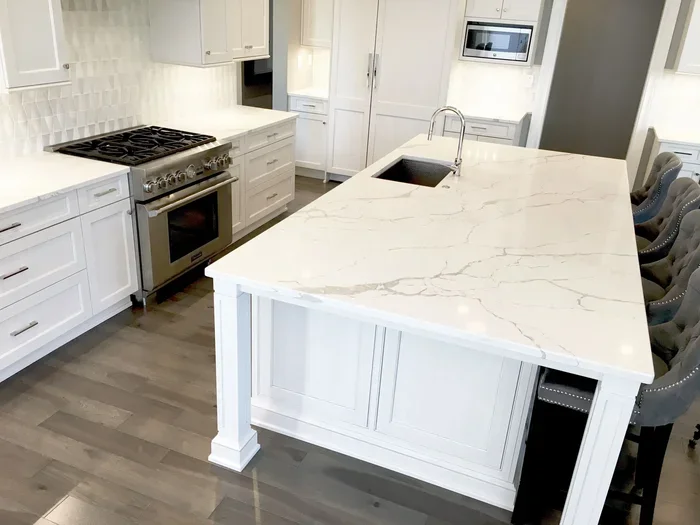
A simple rectangular kitchen with straight runs is the easiest and cheapest to install. L-shaped kitchens, kitchens with islands, and those with unusual angles require more cutting, more seams, and more labor. If your kitchen has a complex layout, expect to pay on the higher end of the price range for quartz kitchen countertops. The number of cutouts for sinks and cooktops also affects the cost.
Sink and Cooktop Cutouts
Undermount sinks are the most popular choice with quartz countertops, but they require precise cutouts that add to fabrication costs. Drop-in sinks are easier to install and cost less. Similarly, cooktop cutouts for gas or induction ranges need careful measurement and cutting. These details might seem small, but they add up quickly in the total quartz countertop cost.
Quartz vs Other Countertop Materials
When choosing a countertop, it helps to compare quartz kitchen countertops with other popular options. Each material has its own price range, benefits, and drawbacks. Let us see how quartz stacks up against the competition.
Quartz vs Granite
Granite is a natural stone that costs between $40 and $80 per square foot installed. Quartz and granite are close in price, but granite requires sealing every one to two years, which adds maintenance costs over time. Quartz does not need sealing and is more consistent in appearance. For most homeowners, quartz kitchen countertops offer better long-term value.
Quartz vs Marble
Marble is a beautiful natural stone, but it is also the priciest option. Marble countertops typically cost $75 to $250 per square foot installed. Marble is also porous and prone to etching and staining, which means regular sealing and careful maintenance. Quartz kitchen countertops deliver a similar elegant look at a fraction of the cost and with far less upkeep.
Quartz vs Laminate
Laminate countertops are the budget-friendly option, costing $20 to $50 per square foot installed. They come in many designs and are easy to replace. However, laminate is less durable than quartz and can chip or stain more easily. If you want a long-lasting, low-maintenance surface, quartz kitchen countertops are a better investment despite the higher upfront cost.
Quartz vs Butcher Block
Butcher block countertops cost between $40 and $100 per square foot, which is similar to quartz. However, butcher block requires regular oiling and is susceptible to scratches and water damage. Quartz is far more durable and resistant to moisture. For a kitchen that sees heavy daily use, quartz is the clear winner.
Quick Cost Comparison Table
Here is a side-by-side look at how quartz kitchen countertops compare to other popular materials:
- Quartz: $40-$100 per sq ft, no sealing needed, 15-25 year lifespan
- Granite: $40-$80 per sq ft, requires sealing, 15-20 year lifespan
- Marble: $75-$250 per sq ft, requires regular sealing, 20+ year lifespan
- Laminate: $20-$50 per sq ft, no sealing needed, 10-15 year lifespan
- Butcher Block: $40-$100 per sq ft, requires oiling, 10-20 year lifespan
As you can see, quartz kitchen countertops offer an excellent balance of cost, durability, and low maintenance. They sit right in the sweet spot for homeowners who want a premium look without the premium price tag of marble.
How to Save Money on Quartz Countertops
Installing quartz kitchen countertops does not have to break the bank. There are several smart strategies you can use to keep costs down without sacrificing quality. Here are some proven ways to save money on your quartz countertop project.
Choose a Mid-Range Brand
You do not need to buy the most expensive brand to get a beautiful result. Mid-range quartz brands like Q Quartz, Silestone, and Cambria offer excellent quality at more affordable prices. These brands use the same manufacturing processes as their premium lines but offer fewer exclusive patterns. The savings can be significant, sometimes $15 to $30 per square foot.
Opt for a Simpler Edge Profile
Fancy edge profiles look gorgeous, but they add to fabrication time and cost. A simple straight or eased edge gives your kitchen a clean, modern look without the extra expense. If you love the idea of a decorative edge, consider adding it only to the front face of the countertop and keeping the back edge simple.
Reduce Seam Count
Every seam in your countertop requires additional fabrication work and adhesive. Choosing larger slab sizes reduces the number of seams and can lower the overall quartz countertop cost. Talk to your fabricator about the largest slab sizes available for your chosen quartz brand. Some brands offer slabs up to 130 inches long, which can cover most kitchen runs in a single piece.
Get Multiple Quotes
Installation costs vary significantly from one fabricator to another. Always get at least three detailed quotes before making your final decision. Make sure each quote includes the same scope of work so you can compare apples to apples. Look for fabricators who offer free in-home measurements and estimates.
Time Your Purchase Wisely
Countertop installation tends to be slower during the winter months and busier in spring and summer. If you can schedule your project during a slower period, you may be able to negotiate a better price. Some fabricators also offer seasonal discounts or promotions on certain quartz brands.
Consider Remnant Slabs
If you have a small kitchen or are adding a second countertop surface like a kitchen island, consider purchasing remnant slabs. Remnants are leftover pieces from previous projects that fabricators sell at a steep discount. You can often find high-quality quartz remnants for 30-50% less than full slab pricing.
Are Quartz Kitchen Countertops Worth the Investment?
This is the big question, and the answer is a resounding yes for most homeowners. Quartz kitchen countertops offer a unique combination of beauty, durability, and low maintenance that few other materials can match. Let us look at the long-term value they provide.
Durability and Longevity
Quartz is one of the hardest countertop materials available. It resists scratches, chips, and stains far better than laminate or butcher block. With proper care, a quartz countertop can last 15 to 25 years or even longer. This longevity means you will not need to replace your countertops anytime soon, making the upfront cost well worth it.
Low Maintenance Requirements
Unlike granite or marble, quartz does not need sealing. You simply wipe it clean with mild soap and water. This saves you time and money on maintenance products and professional sealing services over the life of your countertop. The low maintenance nature of quartz kitchen countertops is one of their biggest selling points for busy homeowners.
Resale Value Boost
Kitchens are one of the most important rooms for home resale value. Updated countertops can increase your home’s appeal to buyers and potentially boost your asking price. According to real estate experts, kitchen renovations with quartz countertops typically recover 60-80% of the investment at resale. This makes quartz kitchen countertops not just a lifestyle upgrade but also a smart financial decision.
Consistency and Design Flexibility
Because quartz is engineered, every slab looks consistent and uniform. This means you can design your entire kitchen around a specific quartz pattern with confidence that it will look cohesive. The vast range of colors and patterns available in quartz kitchen countertops means you can find something that matches any kitchen style, from minimalist modern to classic traditional.
The Bottom Line
When you consider the durability, low maintenance, beauty, and resale value that quartz kitchen countertops provide, the investment pays for itself over time. You are not just buying a countertop; you are investing in a kitchen surface that will look great and perform beautifully for decades. For most homeowners, the cost of quartz is more than justified by the long-term benefits it delivers.
Common Mistakes to Avoid When Buying Quartz Countertops
Even with the best intentions, homeowners sometimes make costly mistakes when purchasing and installing quartz kitchen countertops. Here are the most common pitfalls to avoid so your project goes smoothly.
Skipping the Seams Assessment
Many homeowners focus only on the per-square-foot price and forget to consider how many seams their kitchen layout requires. More seams mean more fabrication work and a less seamless final appearance. Always ask your fabricator to show you a layout diagram before you commit so you understand exactly where seams will be placed.
Choosing the Wrong Thickness
It can be tempting to go with the thinner 2cm slab to save money, but 3cm quartz provides a more substantial feel and better long-term performance. The thin slabs often require plywood backing, which adds to the cost anyway. In most cases, the 3cm option is the better value.
Not Checking Warranty Terms
Different quartz brands offer different warranty coverage. Some warranties cover manufacturing defects for 10 to 15 years, while others are more limited. Before you purchase, read the warranty carefully and understand what is covered. A strong warranty adds peace of mind and protects your investment in quartz kitchen countertops.
Choosing the Cheapest Installer
While saving money is smart, choosing an installer solely based on the lowest bid can backfire. Poor installation can lead to gaps, uneven surfaces, and premature damage. Always check reviews, ask for references, and verify that the installer has specific experience with quartz countertop installation.
Ignoring the Backsplash
Some quotes include a matching backsplash while others do not. Make sure you clarify whether the backsplash is included in the price and what material will be used. A matching quartz backsplash creates a seamless, polished look that elevates the entire kitchen.
Expert Tips for Choosing the Perfect Quartz Countertop
Finding the right quartz countertop for your kitchen involves more than just picking a color you like. Here are some expert tips to help you make the best choice.
- Request Physical Samples: Order samples of your top choices and place them in your kitchen. View them in different lighting conditions throughout the day. This helps you see the true color and pattern in your actual space.
- Consider Your Kitchen Style: Light-colored quartz works well in small kitchens by making them feel brighter and more open. Dark quartz creates a dramatic, sophisticated look in larger kitchens with plenty of natural light.
- Think About Your Lifestyle: If you have a busy household with kids and pets, choose a quartz color with a subtle pattern that hides minor scratches and wear better than solid light colors.
- Match Your Budget Early: Decide on your total budget before you start shopping. This keeps you focused and prevents you from falling in love with a slab that is outside your price range.
- Ask About Lead Times: Popular quartz brands can have lead times of 2 to 4 weeks for fabrication. Factor this into your renovation timeline so you do not experience unexpected delays.
Taking the time to choose the right quartz kitchen countertops for your space pays off every time you walk into your kitchen. The right countertop becomes the centerpiece of the room and sets the tone for the entire design.
Frequently Asked Questions
Are quartz kitchen countertops worth the cost?
Yes, quartz kitchen countertops are worth the investment for most homeowners. They offer excellent durability, require minimal maintenance, and can last 15 to 25 years. The low-maintenance nature and consistent appearance make them a smart choice compared to natural stone options that need regular sealing and care.
How long does quartz countertop installation take?
Professional installation typically takes one to three days depending on the complexity of your kitchen layout. Simple rectangular kitchens with straight runs take less time, while L-shaped kitchens with islands and multiple cutouts take longer. The fabrication process usually takes 10 to 14 days before installation day arrives.
Can I install quartz countertops myself?
While it is technically possible, DIY quartz installation is not recommended. Quartz slabs are heavy and require precise cutting and leveling. Mistakes can be expensive to fix and may void the manufacturer warranty. Professional installation ensures a proper fit and a flawless finish that lasts for years.
Do quartz countertops stain easily?
No, one of the biggest advantages of quartz kitchen countertops is their resistance to staining. Because quartz is non-porous, liquids like wine, coffee, and oil do not penetrate the surface easily. However, dark-colored quartz may show lighter spills more readily, so prompt cleaning is always a good practice.
What is the cheapest quartz countertop brand?
Budget-friendly quartz brands like Q Quartz and some lines from Silestone offer lower price points while still delivering quality and durability. These options typically cost $40 to $55 per square foot installed. Keep in mind that even budget quartz is more expensive than laminate but offers far better longevity and performance.
How do I maintain quartz kitchen countertops?
Maintaining quartz kitchen countertops is incredibly easy. Simply wipe the surface with warm water and mild dish soap. Avoid abrasive cleaners and steel wool pads. Unlike granite or marble, quartz does not need sealing. A quick wipe-down after use keeps your countertops looking brand new for years.
Conclusion
Quartz kitchen countertops are a fantastic investment for any homeowner looking to upgrade their kitchen. With prices ranging from $40 to $100 per square foot installed, they offer excellent value compared to natural stone options like marble and granite. The durability, low maintenance, and stunning design options make quartz a top choice for kitchens of all styles and sizes.
By understanding the factors that affect pricing, comparing brands, and following the money-saving tips in this guide, you can find the perfect quartz countertop that fits your budget and your vision. Take the time to get multiple quotes, choose the right thickness and edge profile, and work with a reputable installer. Your kitchen deserves a surface that looks beautiful and performs brilliantly every single day.
The real worth of quartz kitchen countertops goes far beyond the price tag. It is about the confidence of knowing your countertop will look great for decades, the joy of a kitchen that is easy to maintain, and the pride of a space that adds real value to your home. Make the smart choice and let quartz transform your kitchen into the heart of your home.